
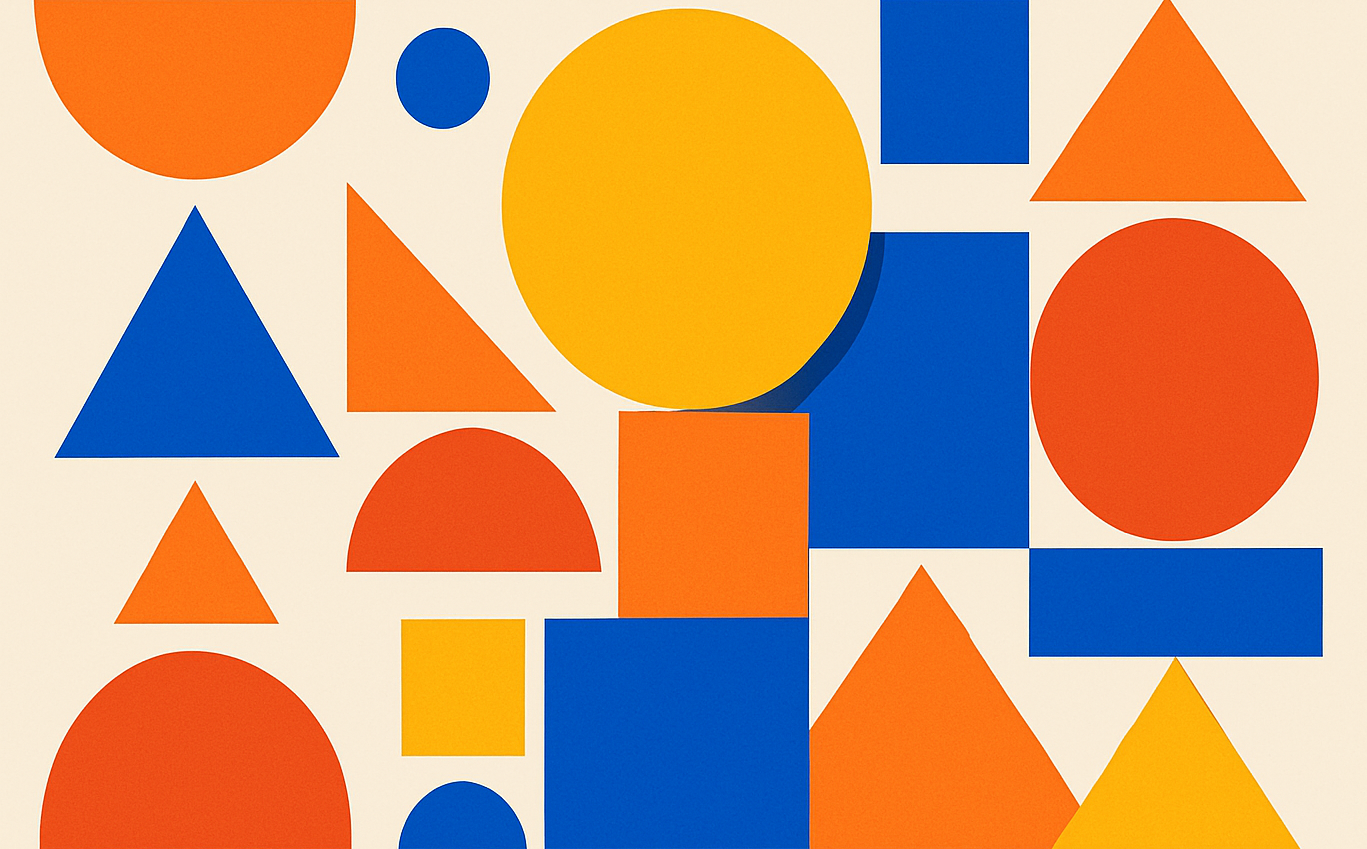
A pivotal reference for this shift is Canva’s “Shape Theory” trend, highlighted in its 2025 design-forecast:
“Shape Theory brings a fresh twist to design by balancing nostalgia with innovation, creating visuals that feel both familiar and forward-thinking. … This modular style uses bold shapes to create structure, complemented by back-lit photography and warm colors for a personal touch.” Canva+2Canva+2
In simpler terms: square, circle, triangle—again—but re-imagined, repurposed, recombined.
For designers and creators, this means we’re no longer merely layering organic textures or chasing minimalism. We’re thinking in systems: modular blocks, shape-led frames, geometric grids. Search-data backs it. As one analyst summary notes:
“In line with the ‘Shape Theory’ trend … there’s a 56 % increase in ‘Shapes’ searches.” Accio
That kind of spike signals that this isn’t just a niche aesthetic—it’s a mainstream shift.
Why shapes matter now
1. Geometry as communication
Shapes provide instant visual language. A circle suggests continuity; a square, stability; a split triangle might hint at disruption. In a world of information overload, design is less about embellishment and more about structure. The resurgence of bold geometry helps clarify hierarchy, guide the eye, and deliver meaning fast.
2. Modular systems fit the pace
With brand touch-points multiplying (apps, social posts, motion, print), modular shape systems make scalability manageable. You design a “shape unit” once, and it adapts across media. This echoes the “modular style” noted under Shape Theory. Canva+1
For firms building service catalogues, layouts or identity systems (like your work at ITG Centro), this modular mindset aligns well: service blocks, shape-driven icons, consistent framing.
3. Nostalgia meets innovation
Canva describes Shape Theory as “balancing nostalgia with innovation.” Canva The implication: vintage geometry (think Bauhaus, art-deco grid) is returning, but layered with modern materials, motion, and tech-informed execution. It’s past + future, through the lens of shape.
4. Shapes support motion and interactivity
Shapes alone are static—but when paired with motion or 3D, they become dynamic. Consider how a modular square might rotate, fold, or morph in animation. As one design trends article notes, moving from 2D to 3D is part of the current landscape. Creative Boom+1
This means shapes aren’t just “flat design elements” any more—they’re platforms for interaction.
Practical implications for your catalog and workflow
Since you’re creating a detailed service catalogue across IT/Server management, Data Management, Security Systems, Graphic Design & Multimedia for your brand (ITG Centro), here are actionable ways to integrate shape-centric ideas:
- Service modules as shape units: When you list “Server Setup”, “RAID Configuration”, “OS Install”, wrap each in a consistent shape (e.g., a rounded rectangle or hexagon) with a unique accent color. The modularity simplifies expansion and visually aligns.
- Graphic Design section powered by shape frameworks: In your branding & identity services, highlight how you use geometric grids and shape systems to create logos, motion graphics, and animations. For instance: “Our brand-kit uses a modular grid of circles and triangles to generate logos that scale cleanly across print, web and animation.”
- Visual consistency with shape tokens: Across website, brochures, animations, define shape tokens (e.g., circle for “consult”, triangle for “install”, square for “maintain”). That way your entire ecosystem speaks a unified shape-language.
- Motion & multimedia design: When you create animations (e.g., your “drag-and-drop logo” GUI or 10-second loop animation), leverage shape transitions: modules that expand, contract, rotate, break apart. It ties to the trend of shapes supporting motion.
- Positioning in copy and marketing: Use phraseology like “structured modular geometry”, “shape-driven interface”, “grid-based visual architecture” in your service descriptions to align your brand with this trending design language.
What to watch/ask next
- Shape + accessibility: Bold geometric design is striking—but ensure usability: shapes should serve clarity not hinder it (e.g., enough contrast, clear semantics).
- Modularity vs. uniqueness: While modular shapes speed creativity and brand consistency, beware of becoming too templated or generic. Stay flexible.
- Motion-enabled shapes: As motion becomes more accessible, shape systems that animate will stand out. Consider proposing “animated shape units” as a higher-tier service.
- Shape systems in 3D/AR: With increasing emphasis on virtual/augmented reality, how do your shape modules translate into space? Think depth, extruded geometry, interactive modules.
- Context-driven shape semantics: Shapes aren’t universal—context matters. A triangle in one cultural context implies caution; in another, play. Shape systems should consider audience.
Looking ahead to November and beyond
November serves as a pivot month: as brands gear up for Q4 real-world projects, they’re seeking visuals that scale and unify. Shape-centric systems provide that. Meanwhile, as we move into 2026, expect the shape narrative to evolve further: interactive modular systems, shape-driven UI design, and shape tokens becoming part of brand architecture.
For you, this is a moment to lean in: shape-driven branding, modular service visuals, animated geometry and clear structure can become differentiators. Whether for a website, service brochure, or animated explainer, acting on the shape trend now positions you ahead of the curve.
If you like, I can pull together five key shape-and-modular design case studies (from branding, UI, motion design, architecture, print) with visuals and link them to how you can adapt them in your service catalog for ITG Centro. Would that be helpful?