
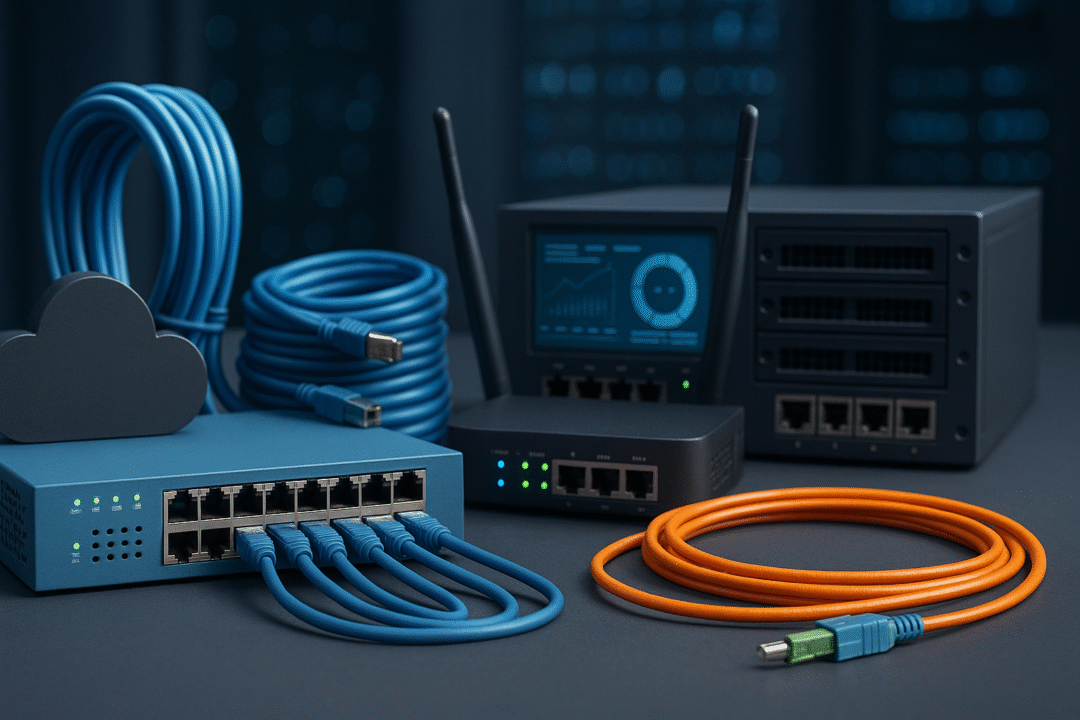
The networking landscape in 2025 is evolving at a rapid pace. For organizations like your offering IT infrastructure, server management, security systems, data management and connectivity, understanding the new tools and equipment becoming mainstream is essential. These innovations not only support performance and scale, but also security, manageability and futureproofing. In this article, we’ll explore the key categories of new networking tools/equipment, what features are driving them, and how you can incorporate them into your service catalogue.
1. AI-Powered Network Management & Monitoring Systems
One of the most significant shifts is the rise of AI-driven network tools that automate tasks once done manually. According to recent analyses:
- AI is now used for routing optimization, traffic tagging, QoS (quality of service) changes and even anomaly detection. Plixer+2PacketFabric+2
- Network monitoring platforms now integrate AI/ML models to spot unusual behavior (e.g., unexpected packet flows, latency spikes) and alert IT teams faster. Exabeam+1
What to highlight in your service offering:
- A “Smart Network Analytics” service: deploying monitoring systems that use AI to alert on performance and security issues.
- Offer proactive performance tuning: using AI recommendations to optimize routing, bandwidth and devices.
- Emphasize faster MTTR (mean time to resolution) as a benefit, as AI narrows down root-causes faster.
2. Next-Gen Connectivity Equipment: Wi-Fi 7, Edge Devices & Optical Links
Connectivity equipment itself is undergoing a refresh. Some of the major equipment categories include:
- Wi-Fi 7 access points and routers catering to extremely high-throughput, dense device environments (e.g., AR/VR, IoT). Pomeroy
- Edge computing devices and adaptive networking gear, because more traffic is shifting to the edge (closer to users/devices) and needs local compute/management. netsync.com
- Optical interconnects, high-bandwidth switches, especially in environments supporting AI workloads or massive data flows. One report noted that copper is becoming insufficient for the highest-speed links, so optical is gaining ground in equipment upgrades. Barron’s
Service-catalog implications:
- “Edge Network Deployment”: offering service to install and manage new edge-devices (local compute + connectivity) with appropriate equipment.
- “High-Speed Connectivity Upgrade”: retrofitting clients’ infrastructure with Wi-Fi 7, optical fiber links or next-gen switches.
- “Device-dense environment support”: for clients with many IoT or AR/VR devices, specify the equipment (Wi-Fi 7 APs, smart switches) needed and deliver full setup.
3. Network as a Service (NaaS) & Virtualized / Software-Defined Hardware
The traditional model of buying physical hardware for networks is giving way to more flexible models:
- The shift to Network-as-a-Service (NaaS) means organizations lease network capability (hardware + software) in an on-demand fashion rather than capital-heavy purchases. Packet Fabric
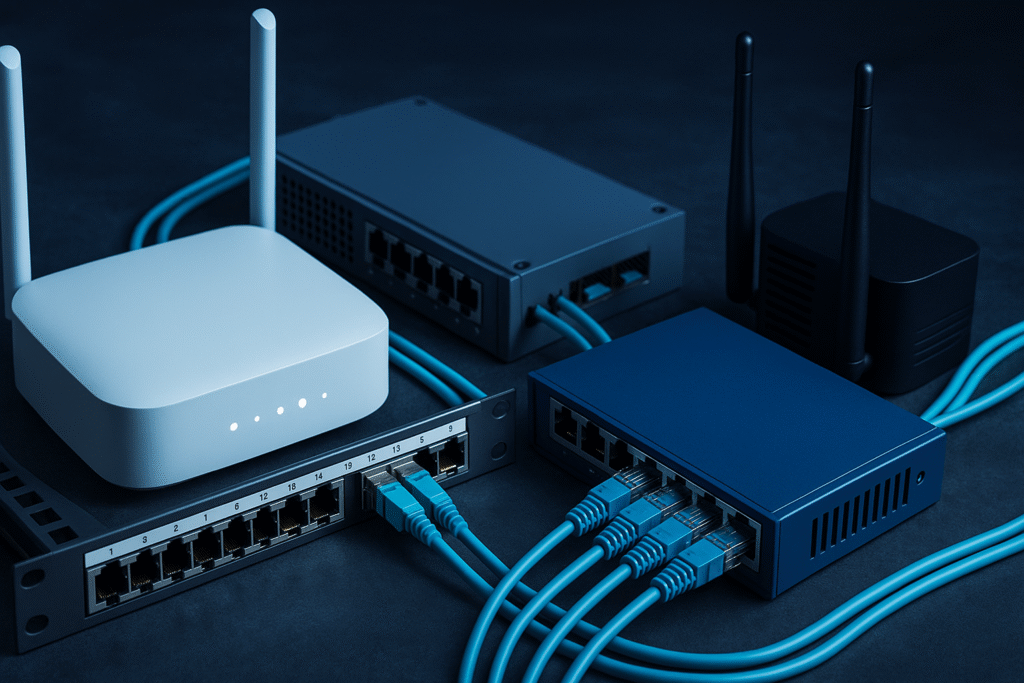
- Software-Defined Networking (SDN) and Network Function Virtualization (NFV) are more widely used. Instead of managing many physical boxes, organizations deploy software-controlled functions that run on generic hardware. PacketFabric+1
How this fits your offerings:
- Offer “Managed Connectivity” service: you manage the network layer as a service for small/medium clients, handle provisioning, monitoring, upgrades.
- For “Server & Network Infrastructure” category: include SDN implementation, NFV appliances (e.g., virtual firewalls, virtual switches) as part of the service breakdown.
- Emphasize lower CapEx and faster deployment time as benefits for clients.
4. Security-Integrated Network Tools & Equipment
In the current environment, network connectivity and security are increasingly intertwined. Key tools include:
- Equipment with embedded security features: network switches and routers now come with built-in threat detection, isolation, zero-trust support.
- Secure Access Service Edge (SASE) models: combining wide-area network (WAN) capabilities with cloud-based security controls, creating a unified connectivity + protection approach. Pomeroy+1
- Enhanced monitoring tools that combine performance metrics with security telemetry (e.g., traffic for latency + features for intrusion detection) in one dashboard. Exabeam
Service insights for you:
- Under your “Security Systems / Connectivity” bundle: promote “Secure Network Infrastructure” which deploys next-gen switches/routers with integrated security, plus policy configuration, monitoring.
- “Zero-Trust Network Implementation”: gear selection + configuration for clients migrating to modern zero-trust networking architectures.
- “Network Visibility & Analytics”: selection of equipment and tools that give deep visibility into both performance and security.
5. Sustainability, Management & Infrastructure-Simplification
Finally, equipment and network tools are increasingly chosen for their operational efficiency, manageability and sustainability:
- More energy-efficient networking gear and green networking design is becoming a differentiator. Pomeroy+1
- Remote configuration, zero-touch provisioning, and cloud-managed network gear reduce operational burden. netsync.com
- Convergence of management platforms: you’ll see unified consoles for wired, wireless, WAN, cloud networks; reducing need for multiple specialized tools.
Service angle:
- “Simplified Network Management”: selection and deployment of equipment that supports centralized cloud-based management, saving client operational expense.
- “Network Infrastructure Audit & Upgrade”: you audit clients’ legacy network gear, recommend newer, more efficient tools and execute upgrades.
- Emphasize sustainability as a value: greener network gear, lower power usage, lifecycle-friendly replacements.
Conclusion
For 2025 and beyond, the tools and equipment that make up network infrastructure are no longer static boxes in closets—they are intelligent, software-driven, flexible, and security-integrated. As you build your comprehensive service catalogue for ITG Centro, align your offerings with these trends: AI-enabled monitoring, Wi-Fi 7/edge connectivity, NaaS/SDN models, security-first networking gear, and efficient, manageable infrastructure. Clients will increasingly ask not just “do we have enough connectivity?”, but “is our connectivity smart, secure, scalable and manageable?”.
If you like, I can draft a detailed service package (bullet-point style) for your “Networking & Connections” category—covering equipment selection, monitoring tools, deployment & warranty support—tailored for small to medium businesses. Would you like me to create that?