
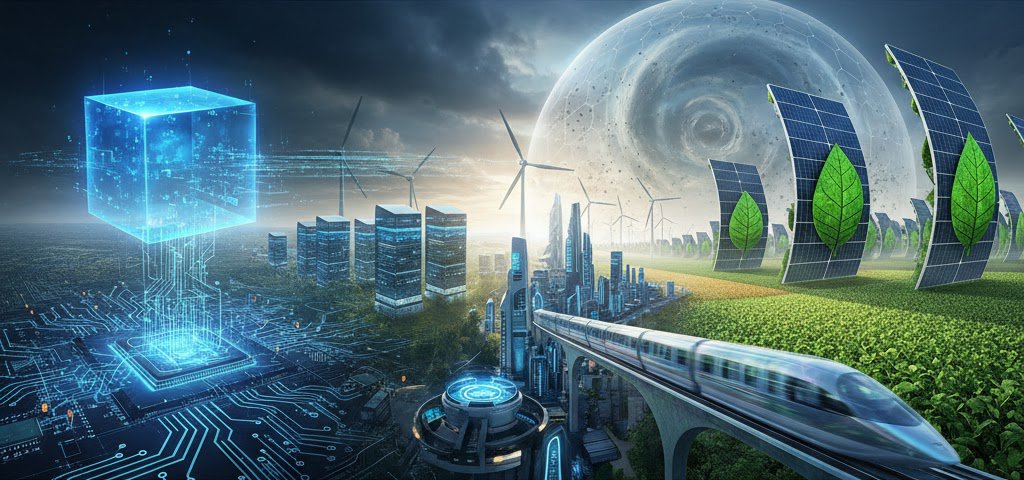
The relentless march of innovation continues to redefine the boundaries of what’s possible, ushering in a new era where technology isn’t just a tool but a fundamental force reshaping industries, economies, and daily life.1 The latest breakthroughs are no longer incremental; they are disruptive and convergent, with once-separate fields—like computing, biology, and material science—beginning to intersect, leading to revolutionary advancements. From the microscopic world of biology to the abstract realm of quantum mechanics, a few key areas stand out as the primary engines of this transformative wave.
1. The Autonomous Intelligence Revolution: Generative AI and Agents
The advancements in Artificial Intelligence (AI), particularly Generative AI and the rise of autonomous Agentic AI, represent perhaps the most visible and immediately impactful innovation.
Generative AI’s Creative Leap
Generative AI models, such as Large Language Models (LLMs) and diffusion models for image creation, have moved from being novelties to being powerful productivity tools.2 The latest evolution focuses on multimodality, where AI can seamlessly process and generate information across various formats—text, image, code, audio, and video—within a single interaction.3 This is accelerating content creation, software development, and scientific research. For instance, AI is now being used to rapidly generate complex code snippets, design novel protein structures, and summarize vast corpuses of data for data-driven decision-making in real-time. The technology is democratizing capabilities that were once exclusive to experts, enabling widespread human-machine collaboration.
The Rise of Agentic AI
A more profound shift is the development of Agentic AI—autonomous systems capable of performing a sequence of complex tasks to achieve a high-level goal, often without continuous human intervention.4 These “agents” go beyond simple query-and-response; they can plan, execute, monitor, and adapt. For a business, this could mean an AI agent autonomously managing a complex customer service workflow, from identifying the issue to executing the solution across multiple software platforms. In robotics, this translates to advanced cobots (collaborative robots) and humanoid robots that learn and operate efficiently alongside human workers in manufacturing, logistics, and even domestic settings.
2. Computing at the Limits: Quantum and Neuromorphic Systems
The very foundation of computation is being reimagined with breakthroughs in quantum computing and neuromorphic computing.5
Quantum Computing’s Stability Breakthrough
Quantum computing is poised to solve problems currently intractable for classical supercomputers, particularly in molecular simulation for drug discovery, material science, and complex optimization.6 The challenge has always been qubit stability and error correction.7 Recent innovations have focused on practical error correction algorithms that can run on commercially available, non-customized hardware, marking a crucial step toward building stable, fault-tolerant quantum computers.8 Furthermore, the development of high-speed interconnects, like NVQLink, is paving the way for hybrid quantum-classical systems, where the specialized power of quantum processors is tightly coupled with the general-purpose strength of GPU supercomputing, accelerating research and the path to real-world applications.9
Neuromorphic Computing: The Brain-Inspired Chip
Neuromorphic computing is an innovative architecture that physically mimics the structure and function of the human brain.10 Unlike traditional Von Neumann architectures that separate processing and memory, neuromorphic chips integrate them. This allows for massive parallel processing and is vastly more energy-efficient, making it ideal for edge computing and real-time AI tasks like image recognition and sensor data analysis in smaller devices. This technology is creating highly efficient, low-power hardware specifically designed for the AI-driven world.
3. Sustainable Technology: Cleantech and Bio-Innovation
The climate crisis and the quest for sustainability are driving urgent innovation in Cleantech and Biotechnology, moving from niche concepts to large-scale industrial solutions.11
Cleantech’s Energy and Carbon Solutions
In the energy sector, the focus is on achieving stability and efficiency alongside clean power. Innovations include next-generation solar panels with record-breaking efficiency (such as tandem solar cells), and AI-driven smart grid management systems that optimize the distribution of energy from distributed renewable sources.12 Beyond generation, significant progress is being made in Carbon Capture, Utilization, and Storage (CCUS) technologies, including advanced Direct Air Capture (DAC) systems that are becoming more compact and energy-efficient. Furthermore, there’s growing interest in modular, safe nuclear power to meet the exponentially increasing energy demands of AI data centers, which are straining conventional grids.13
Biotechnology’s Green and Health Frontiers
Biotechnology is increasingly providing sustainable alternatives to traditional industrial processes.14 In material science, synthetic biology is enabling the creation of new marine-biodegradable bioplastics (like advanced PHAs) derived from microbial fermentation, offering a viable path to combating plastic pollution.15 In agriculture, biotechnology is developing climate-resistant crops and advanced bio-stimulants based on microalgae, which act as significant 16$\text{CO}_2$ sinks.17
On the health front, the combination of AI and biotech is accelerating drug discovery by using AI to simulate complex molecular interactions and identify promising therapeutic compounds far faster than traditional research.18 Personalized medicine, driven by genetic editing techniques like CRISPR, is moving toward highly-tailored treatments that target a patient’s specific genetic makeup, promising breakthroughs in treating complex, drug-resistant diseases.19
Conclusion: The Converging Future
The latest wave of technological innovation is characterized by convergence.20 AI is not just a standalone technology; it’s an accelerant for quantum computing, cleantech, and biotech. Quantum computers, in turn, will unlock even more powerful AI capabilities.21 These interconnected advancements are collectively moving us toward a future defined by greater computational power, more personalized healthcare, and a stronger commitment to environmental sustainability. The challenges of scaling these technologies—from securing funding to addressing ethical and security concerns—remain, but the innovations emerging today promise to fundamentally upgrade our ability to solve the most pressing problems of the 21st century.
Reference Links
- Generative AI & Agentic AI:
- The rise of autonomous systems and new human–machine collaboration models.
- Generative AI and LLMs for content, code, and scientific research.22
- Quantum & Neuromorphic Computing:
- Breakthroughs in quantum error correction and hybrid quantum-classical systems.23
- The development and application of neuromorphic computing architectures.
- Cleantech & Biotechnology:
- Advancements in carbon capture, next-generation solar, and sustainable energy infrastructure.
- Synthetic biology for bioplastics, and AI-driven drug discovery and personalized medicine.