
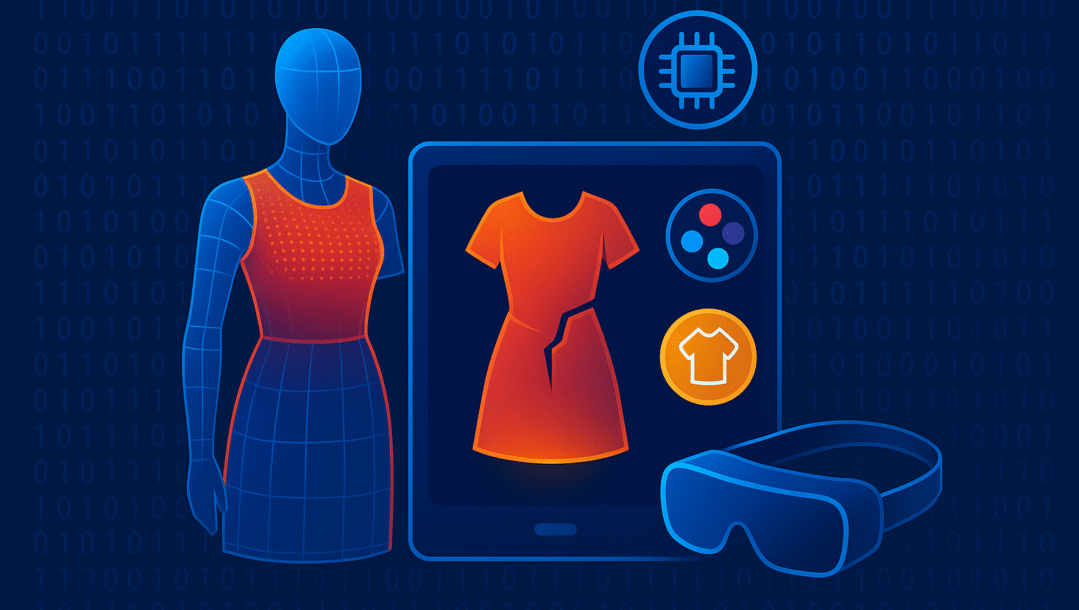
The fashion industry in 2025 is seeing a major transformation: technology is no longer just a back-end tool, it’s becoming an integral part of how garments are conceived, produced, and experienced. The Interline+3Vogue Business+3The Design Village+3 Designers and brands are leveraging innovation in three overlapping layers: design & materials, production & supply chain, and consumer experience & digital fashion.
1. Design & Materials Innovation
- Smart and responsive fabrics: Materials embedded with sensors, dyes that change color, fabrics that adjust to body temperature or movement are gaining traction. Techpacker+1
- Biomaterials and sustainable tech textiles: The shift toward mycelium-leather, bacterial-cellulose fabrics, and fabrics engineered for lower energy, lower waste production is accelerating. Wikipedia+2The Design Village+2
- Generative design tools: Designers are using AI to explore new silhouettes, textures, and patterns — blending human creativity with algorithmic assistance. SG Analytics+1
Why this matters for your service catalogue:
You could position your graphic/multimedia services alongside fashion tech by offering “material-innovation consulting” or “interactive fabric visualization” (e.g., animation previews of how smart textiles react). For your IT domain you might support designers with backend systems for material data, supply-chain traceability, or IoT sensor integration in garments.
2. Production & Supply Chain Tech
- 3D design and sampling: Instead of endless physical prototypes, many brands use 3D modelling, virtual try-ons, and digital twin creation to shorten lead times and reduce waste. The Interline+1
- Just-in-time & micro-factories: The traditional “order months ahead” model is being challenged by small-run micro-factories and on-demand weaving/knit machines that reduce overproduction and stock wastage. Vogue Business+1
- AI & data-driven inventory/forecasting: Brands are deploying AI to analyze trend data, social-media cues, and sales patterns to align production more closely with actual demand. Glance+1
Service-catalog angle: For your IT/data-management domain you could frame services like “AI-driven demand forecasting for fashion brands”, “3D product-data infrastructure for sample workflows”, “IoT-enabled manufacturing dashboards”. For peripherals/security you might include services for tracking smart-textile sensor data, securing fabric tech IP, or implementing blockchain/traceability.
3. Consumer Experience & Digital/Virtual Fashion
- Virtual fashion, NFTs & metaverse wearables: The concept of fashion is expanding beyond physical garments to digital assets — virtual clothes, avatar skins, limited-edition fashion NFTs. World Economic Forum+1
- Augmented reality (AR) & smart mirrors / fitting rooms: Trying on clothes virtually, customizing in real time, mixing physical and digital experiences in-store or at home. Glance+1
- Hyper-personalization: AI styling assistants review body-type, wardrobe history, preferences and suggest custom fits, bespoke designs or smart garments tuned to the wearer. SG Analytics+1
Marketing & design tie-in: Your graphic/multimedia work could support brands with interactive AR-based fitting-room animations, virtual runway experiences, motion-graphic previews of digital wearables. In your IT domain you might support backend services for virtual wardrobe management, identity/authentication of NFT wearables, or secure storage of digital fashion assets.
4. Key Benefits & Challenges
Benefits
- Speed: Faster design-to-market cycles with 3D/AI tools. The Interline+1
- Sustainability: Reduced waste, more efficient production, smart textiles. The Design Village+1
- Differentiation: Brands can offer innovative products (smart garments, AR experience, digital exclusives) and engage customers in new ways.
Challenges
- Tech-human balance: Automation must support, not replace, human creativity. Vogue Business
- Data & infrastructure: Supporting advanced tech demands strong IT/back-end, sensor data, 3D assets, secure systems.
- Cost & scalability: Some innovations (biomaterials, micro-production) still have higher cost or complexity.
- Consumer adoption & trust: Virtual/digital fashion is still emerging; brands must educate and engage consumers.
5. How this Applies to You (ITG Centro)
Given your dual focus on IT/data/multimedia + design, you’re uniquely positioned to offer a service that bridges both worlds:
- For fashion-brand clients: Offer consulting on integrating smart textile systems, implementing the digital-asset pipeline for 3D design, or building virtual try-on & AR experiences.
- For your graphic/multimedia offerings: Provide motion-graphic animations of smart garments, interactive digital fashion show previews, or digital-wearable concept visualizations.
- For your infrastructure services: Provide secure data systems for garments with embedded sensors (IoT), cloud/edge storage for virtual wardrobe assets, backup & recovery for design studios, network setup for micro-factories.
- For your website/blog or marketing materials: Frame a narrative around “technology enhanced fashion design” and the convergence of creativity + code + data. You might craft a “Fashion Tech & Creative Services” section in your catalogue.
Conclusion
Technology is no longer just an after-thought in the fashion world—it’s a core driver of how garments are designed, made, and experienced. From smart fabrics and AI-generated styles to virtual wearables and rapid micro-production, the fashion of 2025 is as much about data, code and infrastructure as it is about silhouette and color.